
Since its inception in 2022 as the “Case Study Competition,” the Winter Simulation Conference (WSC) Simulation Challenge has consistently emphasized the vital role of simulation in bridging the gap between academia and industry. This initiative is rooted in fostering interdisciplinary collaboration, driving innovation, and addressing real-world challenges through advanced simulation technologies.
This year, aligning with the WSC 2026 theme “Simulation for Climate Resilience,” the Challenge focuses on demonstrating how discrete‑event simulation can act as a decision‑enabling infrastructure for managing climate‑induced disruptions in complex maritime logistics systems. Rather than emphasizing model construction, the Challenge shifts toward empowering participants to develop dynamic, resilience‑oriented decision policies for liner‑shipping networks exposed to stochastic climate disruptions. Participants are invited to design, optimize, and evaluate adaptive decision algorithms—covering vessel deployment, port‑level operations, and cargo routing—within a standardized simulation environment. The goal is to enhance system adaptability and minimize transport delays under extreme climate uncertainty, reflecting the growing need for resilient maritime logistics in an increasingly volatile global environment.
We are excited to announce that the 2026 Simulation Challenge is co-organized by the Department of Industrial Systems Engineering and Management (ISEM) at the National University of Singapore (NUS) and the Department of Engineering at the University of Exeter (United Kingdom), showcasing the global and interdisciplinary nature of this event.
This competition offers participants a unique opportunity to engage with industry leaders, gain recognition for their innovative contributions, and compete for prestigious awards. Participants will also have an opportunity to present their solutions at the conference, showcasing their work to key professionals in the maritime sector and gaining valuable recognition. Through this challenge, we aim to inspire the next generation of simulation professionals to shape the future of maritime operations.
Special Thanks to our Executive Simulation Challenge Sponsor

Signature Simulation Challenge Sponsors


Problem Description
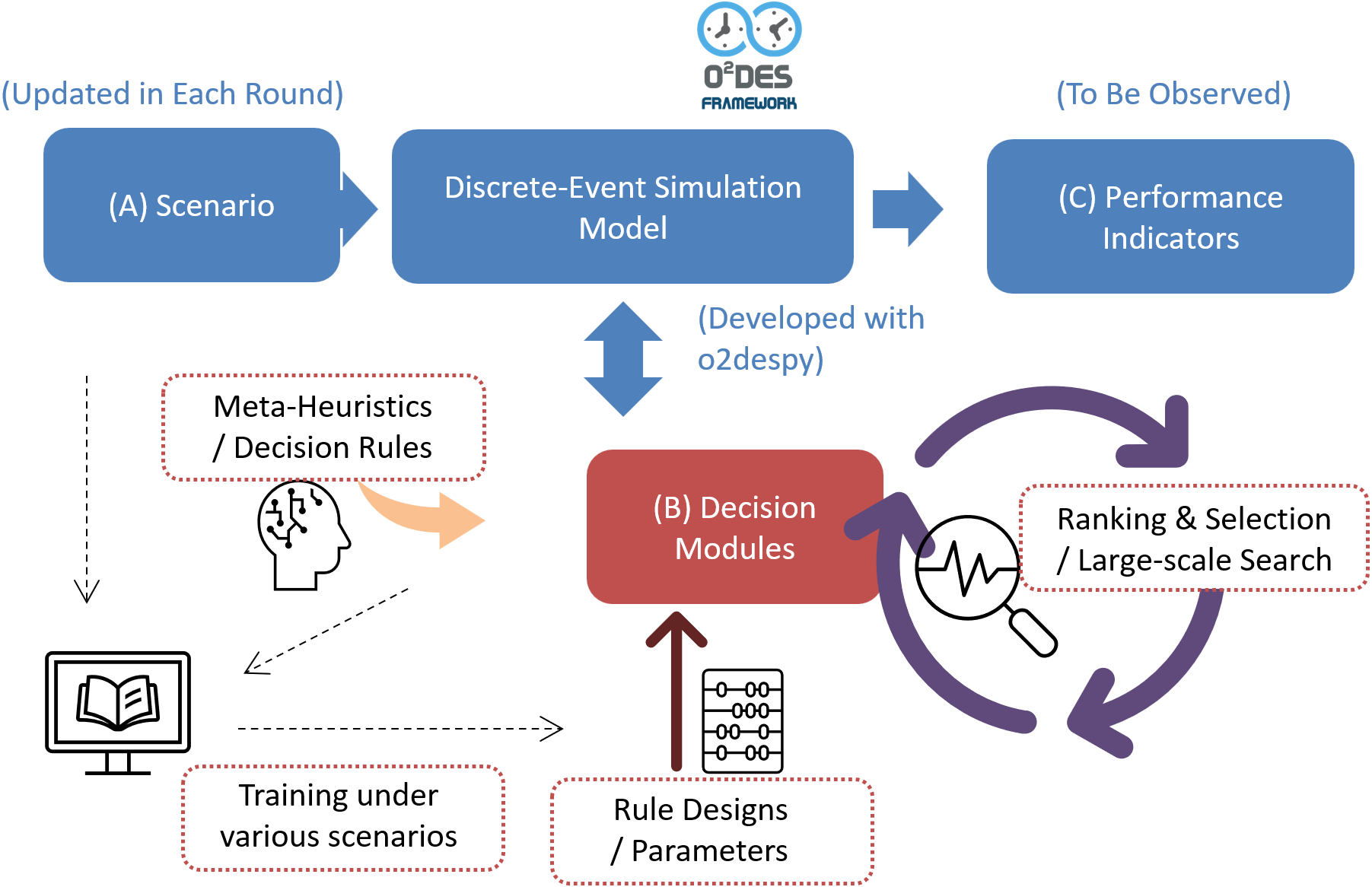
This year’s Simulation Challenge focuses on maritime logistics under climate‑induced disruptions, centered on a liner shipping network that spans multiple ports, circular service routes, finite‑capacity vessels, and stochastic container demand. Participants will design strategies that enhance operational efficiency and system resilience when facing climate‑driven sailing delays, congestion propagation, and uncertain network conditions. The organizers will provide a basic simulation model using discrete-event modeling methods and which is implemented in an open-source DES framework (i.e., o2despy). In order to ensure clarity and accessibility for all participants, a comprehensive document to describe the model structure according to the rigorously defined modeling formalism will also be provided to ensure clarity and accessibility for all participants.
The organizers will supply the data and source code according to the following three aspects of information:
- The variable scenario parameters, based on dynamic port operation: real‑time demand, resource availability, and disruptions.
- The key decisions and default rules involved in the operation of the system, such as routing/path planning, task assignment and sequencing.
- The performance indicators used to measure the efficiency and quality of the system operations.
Competition Objective
The competition requires participants to refine decision modules within a simulation model of a maritime logistics network. The goal is to optimize performance indicators based on various scenarios defined by the input data source, streamline operations, alleviate bottlenecks, and improve resilience against external challenges like port congestion, vessel capacity limits or climate‑induced sailing disruptions.
Key Areas for Decision Module Enhancement include:
- Shipping line operations (vessel deployment, service rerouting).
- Port/terminal operations (berth allocation/scheduling, vessel priority rules).
- Cargo routing decisions (adaptive path selection).
By focusing on these specific decision variables and applying advanced simulation techniques, participants are expected to provide insights that will help optimize maritime logistics operations and may, potentially influence global trade efficiency.
Participants are required to:
- Rewrite and replace the existing decision modules (in block B) to maximize the performance indicators (in C) under various scenarios (given in A).
- Generate logic rules in (B) through various ways, including but not limited to:
- Writing rule-based scripts or heuristic algorithms embedded in decision events,
- Embedding this simulation model into some external optimization search algorithms,
- Developing a machine learning model to identify and conclude the best parameters and embedding them in the decision events.
- Provide only their new decision module (i.e., B) of the program code in a dedicated folder, as any other source code (other than B) will not be evaluated.
Assessment
Once all participants have submitted their code and data in (B), the organizers will embed them in the discrete-event simulation model prepared in advance, overwrite the corresponding original code, and compile and generate an executable simulation program.
In this stage, the pre-specified undisclosed scenarios (as in A) and random seeds will serve as the input of the programs. After which, the organizers will run the simulation program of each participant and generate the output of performance index values (as in C).
Documentation
- WSC Simulation Challenge 2026 – Brief: A document that introduces the simulation structure briefly.
- WSC Simulation Challenge 2026 Tech Document:A document that guides participants to participate in the competition and provides detailed illustrations of the simulation system.
Evaluation
During this evaluation stage, the pre-specified undisclosed scenarios and random seeds will serve as the input of the programs. The organizers will then execute each participant’s simulation program and record the output of performance index values. These outputs will form the basis for scoring and final rankings. Projects will be judged solely based on their ability to achieve the shortest possible total time (waiting + service) while maintaining the integrity of the simulation logic.
- The competition begins with a warm-up round, followed by three successive official rounds. As the competition progresses, the weighting assigned to each round increases in proportion to the complexity of the respective scenario.
- Round 0 will begin in July as a warm-up round. The first two official rounds will take place in August and September, with a new scenario released at the beginning of each month. Please refer to the schedule for details. Participants (teams) may submit their work for each round at any point of time before the 23rd of each respective month. Resubmissions are allowed, provided they are made before the deadline of each round. Throughout this period, there will be a dynamic leaderboard which ranks the performance of the submissions we receive. This ranking will be regularly updated as the submissions are evaluated, with the final standings for each round published at the end of the month.
- For each round, teams will be awarded some points. The top ten teams will get points on a descending scale of 100, 95, 90, and so on, down to 55 points. All other teams that submit a valid model will be awarded 50 points.
- Each round carries a different weight. Specifically, the weights assigned to Rounds 1 to 3 are 0.2, 0.3, and 0.5, respectively. Final rankings will be determined based on the weighted sum of points accumulated across all rounds.
- For example, if a team places 5th in Rounds 1, and 2nd in Round 2, and 1st in Round 3, their corresponding points would be calculated as follows: (80×0.2) + (95×0.3) + (100×0.5) = 94.5.
- Unlike previous rounds, the scenario for the final round will not be released. Teams (participants) may choose to submit an updated version of their work for this round or re-submit any of their previous works. All final submissions must be received by 23rd October.
- The Top 5 finalists will be invited to prepare a report presentation for the WSC2026, and the top 6-10 participants (teams) are encouraged to present their work on-site during the event.
Timeline
Round 0: Warm-up Round
Start Date: July 1
- Registration opens
- Warm-up Scenario is released
This warm-up round is intended for practice only. No submissions are required, and no official scores or rankings will be announced.
Round 1
Start Date: August 1
- New Scenario is released
- Submissions for Round 1 open
End Date: August 23
Submissions close for the Round 1.
Evaluation Period: August 24-30
Rankings Announcement: August 31
Round 2
Start Date: September 1
- New Scenario is released
- Submissions for Round 2 open
End Date: September 23
Submissions close for the Round 2.
Evaluation Period: September 24-29
Rankings Announcement: September 30
Hidden Round
Start Date: October 1
- Submissions for Hidden Round open
- No new scenario will be released
- Participants can either:
- submit an updated version of their work OR
- re-submit their previous works
End Date: October 23
Submissions close for the Hidden Round.
Evaluation Period: October 24-31
Rankings Announcement: October 31
Overall rankings will be announced. The top 5 teams will be identified, but their specific ranking order will not be disclosed.
Rules & Registration
Eligibility
To be eligible to enter the competition, all participants must:
- Register for the competition with a valid and active email address which the organizer can use to communicate with the participants.
- Either be a single entrant or part of a team of up to a maximum of five (5) members only. Each participant can only join up to one team.
- Be solely responsible for creating the competition submission. Supervision or advice from the participants’ professors or post-doctoral researchers is permissible.
The competition is open to all except for members of the committee, including all staff members. However, the committee reserves the right to approve or disapprove participation according to its own considerations.
Please download the Registration Document, fill in the relevant content and rename the document to “Registration +Team Name”, and send it to [email protected] to complete the registration.
Submission
Please submit your code in .rar or .zip file. The file name is Round Number + Team Name, eg Round1_TeamN. Make sure you have tested the code in your local computer.
Email address for submission: [email protected]
Prizes
Total Prize Amount (USD): $10,000
- 1st place: USD 2,000 + Complimentary Registration [1 per team]
- 2nd & 3rd places: USD 1,000 + Complimentary Registration [1 per team]
- 4th & 5th places: USD 500 + Complimentary Registration [1 per team]
- 6th to 10th places: Complimentary Registration [1 per team] (if you are willing to attend the conference)
Please Note: We reserve five registration fee reimbursements for any participants who wish to present their work onsite at the WSC2026. These reimbursements are available even to those who are not among the top five finalists, provided they present their work at the conference. Only participants who attend the WSC2026 conference in person will be eligible to receive their ranking certificates and prize money. Participants who do not attend the conference in person will instead be awarded a “Successful Participation Award” in recognition of their effort. 1st place – 5th place winners will need to provide appropriate tax documentation (foreign payees: W-8 ENE and for US payees: W-9).
Contact
For any enquiries, please feel free to drop our Case Competition Chair, Dr. Li Haobin, an email at [email protected] and Co-Chair, Dr. Martino Luis, [email protected]
Terms & Conditions
- The competition committee reserves the right to disqualify any entrant from the competition if, in the competition committee’s sole discretion, it reasonably believes that the entrant has attempted to undermine the legitimate operation of the competition through cheating, deception, or other unfair playing practices.
- Submissions are void if they are in whole or part illegible, incomplete, damaged, altered, counterfeit, obtained through fraudulent means, or late. The competition committee reserves the right, in its sole discretion, to disqualify any entrant who makes a submission that does not adhere to all requirements.
- Officers, directors, employees, and advisory board members (and their immediate families and members of the same household) of the competition organizer and their respective affiliates are not eligible to participate in the competition.
- You agree to use reasonable and suitable measures to prevent persons who have not formally agreed to these rules from gaining access to the software and data provided by the competition organizer. You agree not to transmit, duplicate, publish, redistribute, or otherwise provide or make such software and data available to any party not participating in the competition. You agree to notify the competition organizer immediately upon learning of any possible unauthorized transmission or unauthorized access of such software and data and agree to work with the competition organizer to rectify any unauthorized transmission. You agree that participation in the competition shall not be construed as having or being granted a license (expressly, by implication, or otherwise) under, or any right of ownership in, any of the software and data.
- By downloading the software and data provided by the competition organizer you agree to the following terms:
- You will not distribute the software and data.
- You accept full responsibility for your use of the software and data and shall defend and indemnify the competition organizer, against any claims arising from your use of the software and data.
- By joining the competition, you affirm and acknowledge that you agree to comply with applicable laws and regulations, and you may not infringe upon any copyrights, intellectual property, or patent of another party for the software you develop in the course of the competition, and will not breach of any applicable laws and regulations related to export control and data privacy and protection.
- The competition committee reserves the right to verify eligibility and to adjudicate on any dispute at any time. If you provide any false information relating to the competition concerning your identity, residency, mailing address, telephone number, e-mail address, right of ownership, or information required for entering the competition, you may be immediately disqualified from the competition.
- The winner’s codes and documentation (collectively referred to as “program”) will be kept on the competition website after the competition. Unless otherwise indicated, all copyrights of the program belong to the winner. The program is licensed under MIT license. THIS PROGRAM IS PROVIDED ON AN “AS IS” BASIS, WITHOUT WARRANTIES OF ANY KIND, EITHER EXPRESS OR IMPLIED, INCLUDING BUT NOT LIMITED TO NON-INFRINGEMENT, MERCHANTABILITY OR FIT FOR A PARTICULAR PURPOSE.
- Prizes are subject to the competition committee’s review and verification of the entrant’s eligibility and compliance with these rules as well as the compliance of the winning submissions with the submission requirements.
- Competition prizes do not include tax payment. Any potential winner is solely responsible for all applicable taxes related to accepting the prize.
- The competition committee reserves the right at its sole discretion to terminate, modify, or suspend the competition, or disqualify the participants from the competition.
- For more information about personal data protection, please refer to the Privacy Policy.